
Last updated September 20, 2026
Free on-site gate assessment - hinges, posts, and your LiftMaster or Nice gate operator checked before anything is quoted
The assessment is free and the quote is the invoice.

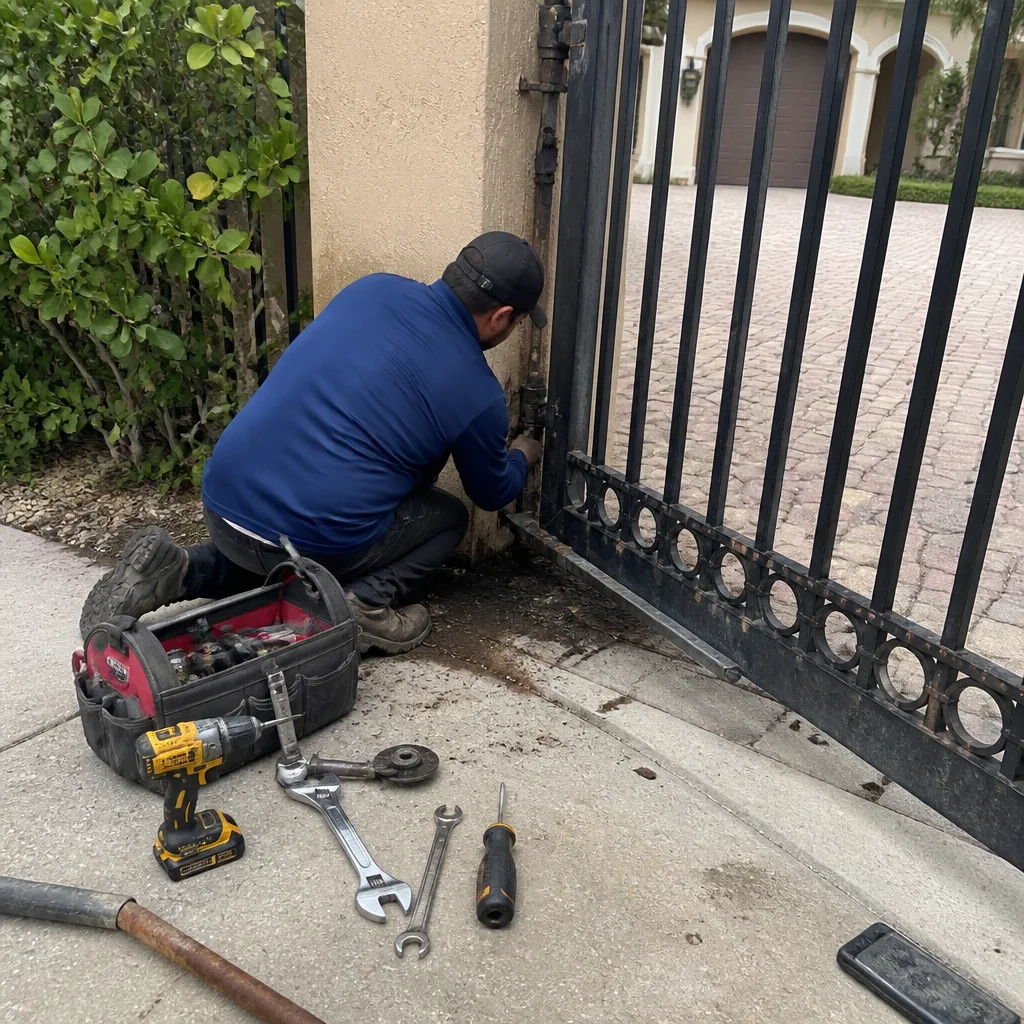 Before
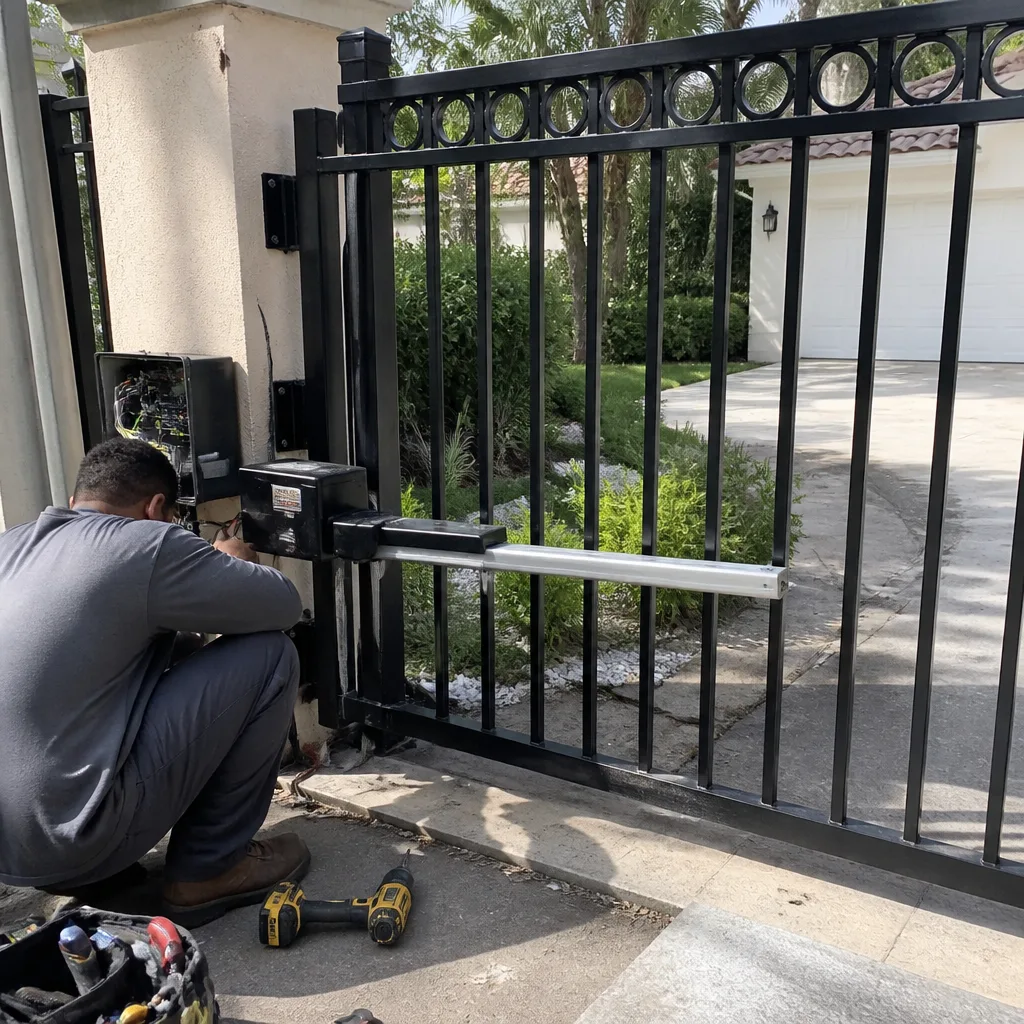 After
After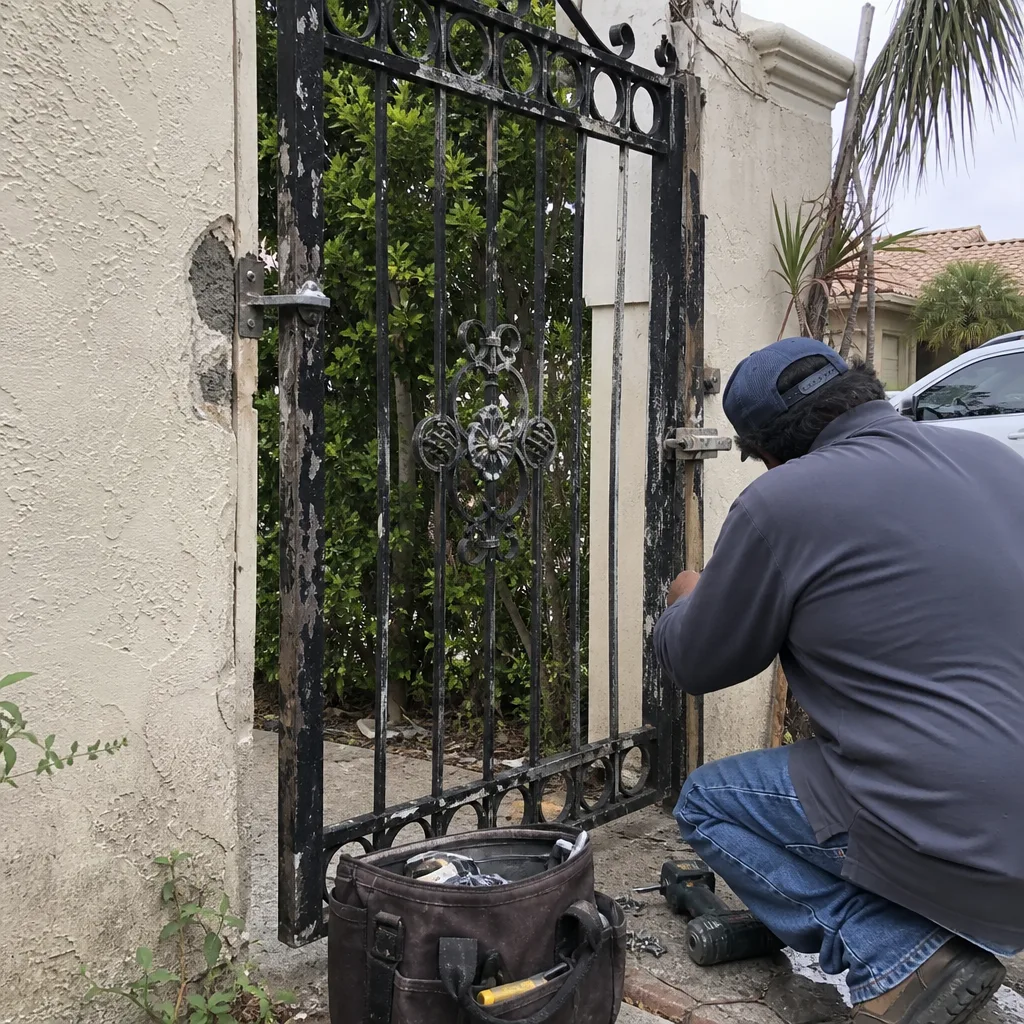 Before
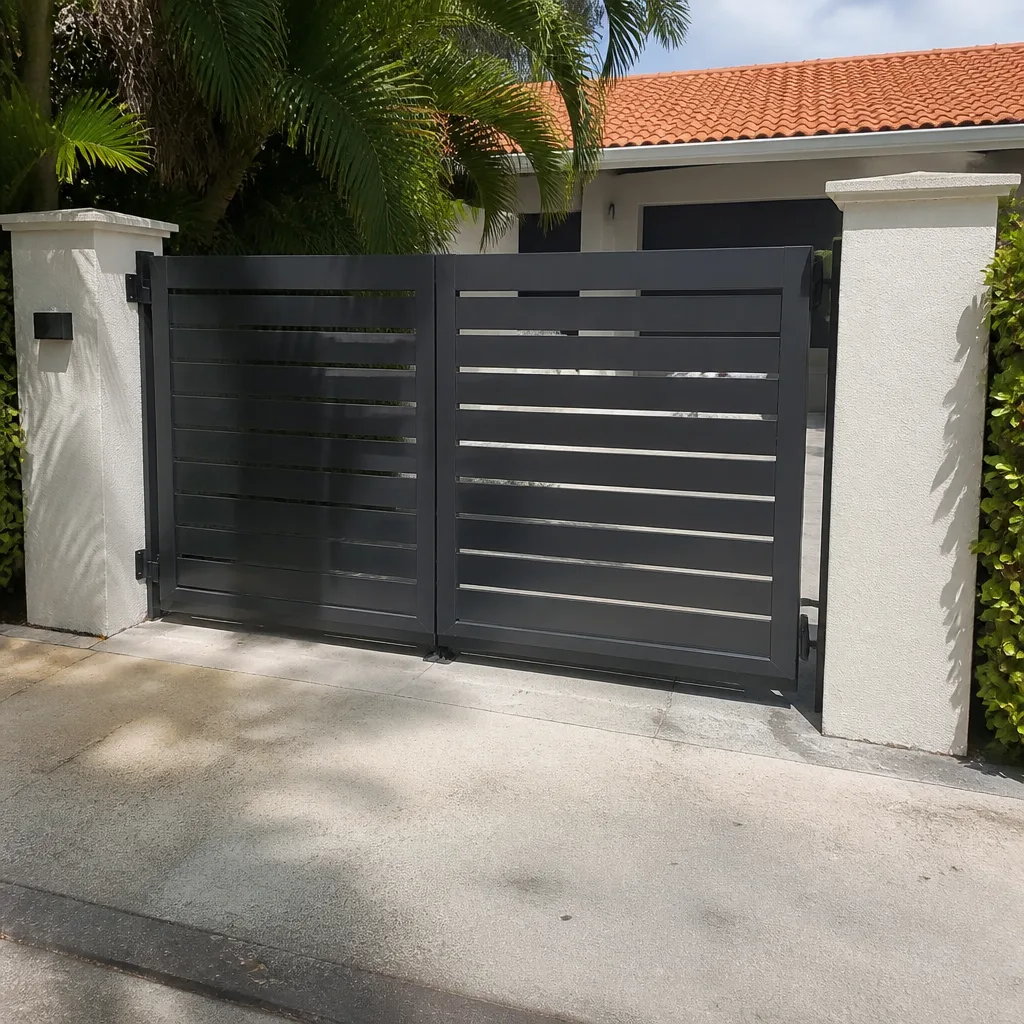 After
After Before
 After
AfterSeasonal Gate Repair Care for West Palm Beach: Year-Round Homeowner’s Guide
November is the month most West Palm Beach gates quietly give up. Hurricane season ends, the air cools, and homeowners who haven’t touched their gate since May finally press the remote and hear nothing but a low hum or a click. The storm didn’t break the gate that week. It damaged it in September, and the failure just waited for the first heavy use. This guide maps the real South Florida climate calendar, not the generic four-season template, and explains what your gate needs before, during, and after each phase so you’re not standing in your driveway at 7 a.m. with a gate that won’t move.
Quick Answer
Seasonal gate care in West Palm Beach means four distinct maintenance windows: a pre-hurricane preparation period in April through May, a storm recovery and inspection period June through November, a dry-season lubrication and metal-fatigue review from December through March, and a brief mild interval for adjustments. Most gate failures here trace to one of three causes: corrosion from salt air, surge damage from afternoon lightning storms, or limit-switch drift caused by repeated thermal cycling in full sun. A written inspection record each season catches these problems before they strand you outside the gate.
Table of Contents
- The Real Climate Calendar: What West Palm Beach Does to Gate Hardware
- Pre-Hurricane Season Checklist (April-May): Tighten, Test, Photograph
- Battery Backup Load Testing: The Most-Skipped Pre-Storm Step
- Post-Storm Inspection Protocol: What Absorbs Surge and Debris Damage
- Dry Season (December-March): Lubrication Schedule and Metal Fatigue Assessment
- Thermal Shutdown and Limit-Switch Sensitivity: Adjusting for Shoulder Seasons
- The Seasonal Log Template: A One-Page Record That Saves Real Money
- Common Mistakes to Avoid
- When to Call a Professional
- Frequently Asked Questions
- The Bottom Line
BeforeAfterThe Real Climate Calendar: What West Palm Beach Does to Gate Hardware
A gate in West Palm Beach lives a different life than a gate in Orlando or Tampa. We’re coastal. We get salt mist off the Atlantic that travels inland further than most people expect, especially during the onshore wind patterns of late summer. We get afternoon thunderstorms that arrive with almost metronomic regularity from June through September, each one carrying a lightning strike risk within a mile or two. We get a dry season that drops relative humidity below 50 percent for weeks at a time, which sounds pleasant and is also when untreated steel starts showing the micro-cracks it developed during the humid months. And we get a hurricane window that concentrates all of these stresses into a four-month period.
What this means for your gate: the maintenance calendar that works in Boca Raton or Palm Beach Gardens is broadly similar, but West Palm Beach properties closer to the Intracoastal or on exposed corner lots face more salt and more wind-driven debris than homes further inland. If your gate is within two miles of the water, shorten every interval in this guide by about 20 percent.
The four phases this guide uses map directly to what the hardware experiences:
- April-May: Pre-hurricane preparation. This is when you want every fastener checked, every sensor aligned, and every battery load-tested before the season starts. It’s the most important maintenance window of the year.
- June-November: Storm season. Gate use drops during the heaviest rains, which means problems hide. This is when surge damage occurs, when debris strikes the gate face, and when moisture gets into housings that were fine in May.
- December-March: Dry season. Humidity drops, temperatures moderate, and this is the best window for metal inspection and lubrication because the low moisture content exposes rust and cracks that humidity conceals.
- Brief mild intervals: Usually late October into early November and again in late March. These are adjustment windows. The gate behaves differently at 78 degrees with low humidity than at 93 with 70 percent humidity, and limit switches set in August may not behave the same by late October.
The rest of this guide walks through each phase in the order you’ll actually encounter it during the year, starting with the most critical: hurricane preparation.
If you’re looking for general gate repair in West Palm Beach, we’ve covered the seasonal approach here, but many of the same principles apply to year-round service needs.
Pre-Hurricane Season Checklist (April-May): Tighten, Test, Photograph
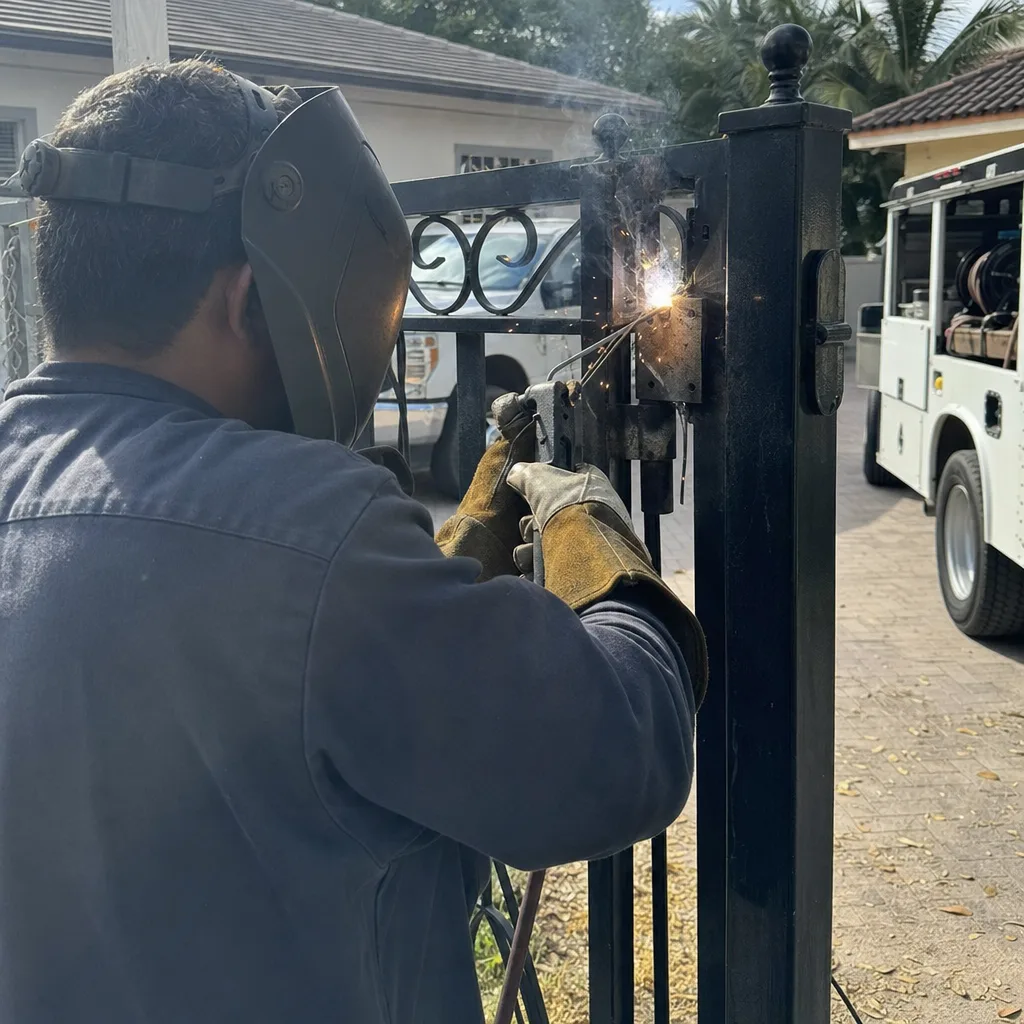
The pre-hurricane window is not about luxury maintenance. It’s about making the gate boring. A boring gate is a gate with no loose hinges, no weak battery, no misaligned photo-eye, and no limit switch that drifts. Every one of those small problems becomes a larger problem when 70 mph wind hits the gate face and shakes every connection on the frame.
Here’s the checklist we follow when servicing West Palm Beach gates in April and May, and it’s what we recommend homeowners run through themselves if they’re hands-on:
- Check every bolt, nut, and bracket on the gate frame and post. Wind load on a solid aluminum gate panel is enormous. A single loose hinge bolt lets the panel flex, and that flex transfers to the motor bracket. What starts as a rattle in May becomes a cracked weld in September. Tighten everything you can reach, and mark any bolt that turns with a paint pen so you know it was moving.
- Test the photo-eyes (infrared safety beams) by blocking the path with something solid. Then test them again with something narrow, like a broom handle. Many photo-eyes fail the narrow-object test because they’re slightly misaligned, and that misalignment means the gate may not reverse when it should. This is a safety item first, but it also prevents the control board from seeing an obstruction that isn’t there and refusing to move.
- Open and close the gate three full cycles, listening for hesitation. A gate that pauses halfway needs limit-switch attention. A gate that shudders at the start of travel needs hinge or wheel service. Record what you hear, or better, record video on your phone. This becomes baseline footage you can compare against after a storm.
- Photograph the gate from both sides, the motor, the control board, and any exterior junction boxes. These photos are your documentation. If a storm damages the gate and your insurance claim requires evidence of pre-storm condition, you’ll have it. If a technician later asks “was that scratch there before?”, you’ll know the answer.
- Trim any vegetation within three feet of the gate’s travel path. Palm fronds and bougainvillea branches become projectiles in tropical-storm-force wind. A branch that would just brush the gate on a normal day becomes a spear at 60 mph.
Every one of these steps takes under an hour for most homeowners. The photo step is the one people skip, and it’s the one that saves the most money after a storm. Documented before-condition is worth more than any repair contract.
Battery Backup Load Testing: The Most-Skipped Pre-Storm Step
Battery backup systems fail in a specific, predictable way: they hold a surface charge, read as healthy on a simple voltage meter, and then collapse the moment they’re asked to actually move the gate under load. That’s the difference between a battery that shows 12.6 volts with no draw and a battery that can deliver enough current to drive a 400-pound gate panel through its full travel arc. The first one looks fine on a multimeter. The second one works in a power outage. They are not the same battery.
This matters in West Palm Beach because hurricane-related power loss is not hypothetical. Even a fast-moving tropical storm can knock out power for 12 to 48 hours, and the gate is typically the first thing a homeowner needs working after a storm for access, especially if the house took roof damage and contractors need to get vehicles in.
A proper load test means disconnecting the backup battery from the charger, connecting it to a load tester, and measuring voltage drop under sustained draw. Most residential gate batteries are 12V sealed lead-acid or lithium replacements. The test takes about 15 minutes. Here’s what we’re checking:
- Voltage under no load: Should read at or above the manufacturer’s specified resting voltage. A reading 0.4V low usually means the battery has already lost capacity.
- Voltage under load for 10 seconds: This is the real test. A healthy battery holds within 0.5V of its resting value. A battery that drops 1.0V or more is done, regardless of what the resting voltage said.
- Recovery after load removal: A healthy battery rebounds within seconds. A battery that takes a minute to recover is showing internal resistance, which means it’s on the way out.
- Physical condition of the battery casing and terminals: South Florida humidity corrodes terminals quickly. Green or white crust on a battery post is resistive, and that resistance becomes heat, and that heat kills batteries faster.
- Control board inspection for surge damage. Open the control board housing and look at the capacitors. A surge from a nearby lightning strike doesn’t always blow the board immediately; it can weaken a capacitor, which then fails a month or two later. Any capacitor that looks domed, discolored, or has a rough texture on top is a replacement candidate. Also check for a faint ozone smell, which indicates arcing occurred inside the board enclosure.
- Photo-eye alignment check. High wind moves brackets. Even a quarter-inch shift in a photo-eye changes the gate’s reversal behavior. After any storm with sustained winds over 40 mph, re-test the photo-eyes with both a solid object and a narrow object.
- Track, wheel, and roller inspection. Storm debris doesn’t always hit the gate head-on. More often, small debris gets kicked up and wedged into the track or roller channel. This causes increased resistance, which causes the motor to draw more current, which shortens motor life. Look for anything lodged in the travel path, and run the gate while watching the wheels for binding or skipping.
- Hinge and weld inspection on the gate frame. Wind loading stresses the weld points first. Hairline cracks in powder coat or paint at hinge points are the early warning sign. If you see a crack in the finish, the underlying metal has been flexing, and that crack will grow.
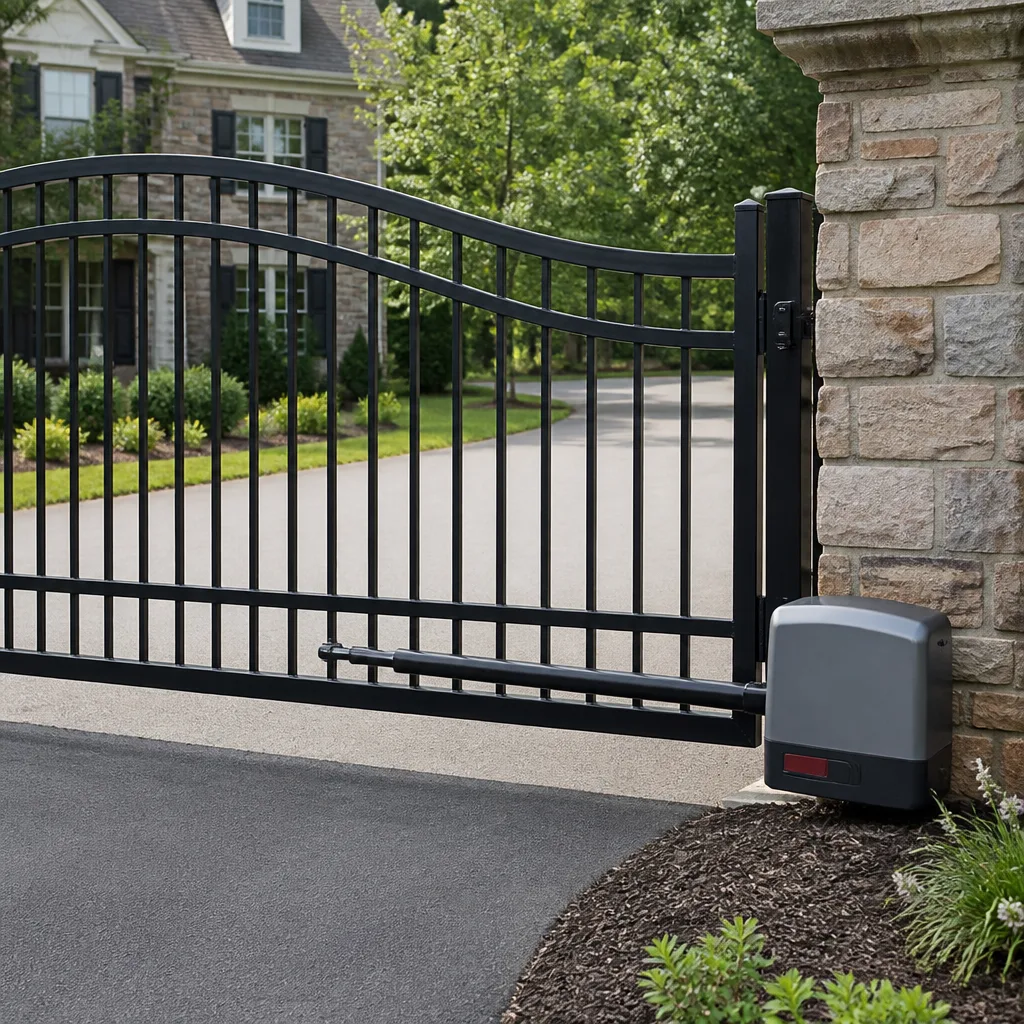
- Motor bracket and arm check. On swing gates, the arm bracket absorbs enormous torsional force in high wind. If the bracket is loose, if the arm has play at the pin joint, or if the bolt holes show elongation, that’s a repair before the next storm.
- Surge protector status. If your gate system has a surge protector on the power supply, check its indicator light. A protector that has tripped has done its job once and will not do it again. Replace it.
- Hinges (swing gates): every 60 days. Use a penetrating lubricant with corrosion inhibitors, not WD-40. WD-40 is a solvent and will strip existing lubrication. You want something like a lithium-based spray or a dedicated hinge lubricant. Apply, cycle the gate twice, wipe the excess.
- Wheels and rollers (slide gates): every 60 days. Same lubricant family. Push the gate manually if possible to distribute the lubricant through the bearing surface.
- Motor gearbox inspection: once in January. Most residential gate motors use a sealed gearbox, so changing the lubricant is not a homeowner task. But checking the gearbox housing for oil seepage or weeping around the shaft seal is. Any seepage means a seal failure, and a seal failure means eventual gearbox failure.
- Chain or belt tension check: once in December. Dry-season temperature changes affect metal chain links and belt tension slightly. A chain that was correctly tensioned in August heat may be slightly slacker in January, and a loose chain causes jerky operation. If the chain deflects more than 3/8 inch with moderate finger pressure, have it checked.
- Full gate frame inspection under raking light: once in February. Raking light means sunlight hitting the gate surface at a low angle, which casts shadows that reveal surface cracks, scratches, or deformation. The low winter sun angle in West Palm Beach is perfect for this. Walk the gate on both sides looking for any line that catches the light differently than the surrounding surface.
- If your gate shuts down only on hot afternoons and recovers within 20 to 30 minutes, it’s thermal shutdown, not a dead motor. Note the pattern, record the outside temperature and the time of day, and call for adjustment rather than replacement.
- If your gate slams or bounces at the end of travel only during certain months, the limit switch is drifting with temperature. A quarter-turn adjustment on the limit cam usually corrects it.
- If your gate reverses mid-travel on hot days, the photo-eyes may be misaligned due to thermal expansion of their mounting brackets, not a failed sensor. Realign and re-tighten the brackets.
- Hinge or wheel condition:
- Photo-eye alignment test (solid object / narrow object):
- Limit-switch behavior (does gate stop cleanly, no bounce):
- Thermal shutdown observed? (Date, time, outside temp):
- Chain or belt tension:
- Battery voltage at rest / under load:
- Rust or corrosion noted (location and severity):
- Lubrication applied (product and date):
- Photos taken this quarter (number and location):
- Lubricating a dirty hinge. Most gate maintenance problems in West Palm Beach are made worse by homeowners who spray lubricant on hinges without cleaning the surface first. Coastal salt and grime mixed with fresh lubricant becomes an abrasive paste. Always wipe the hinge clean, then lubricate.
- Ignoring a gate that still opens “fine.” The November failure pattern exists because gates that work fine in September have been slowly degrading since the last storm. A gate that works fine today can be a gate that won’t move tomorrow. The log and the inspection intervals are the guardrail against this.
- Replacing a motor without load-testing the battery. In West Palm Beach, a high percentage of “dead motor” calls are actually dead batteries or bad battery connections. Replacing the motor doesn’t fix a dead battery, and the homeowner just spent $800 to rediscover the same symptom. Always load-test the battery before replacing the motor.
- Realigning photo-eyes by eye instead of by test. A photo-eye can look perfectly aligned and fail the narrow-object test by a wide margin. The only way to know is to test with a solid object and a narrow object. Eyeballing alignment is checking the wrong thing.
- Waiting until May to think about hurricane preparation. Every April in West Palm Beach, gate service appointments fill up as the season approaches. The hardware doesn’t know what month it is. If you do your pre-hurricane checklist in March, you’ll have time to address any repairs before the demand spike.
- Spraying WD-40 on everything that moves. WD-40 is not a lubricant for gate hardware. It’s a solvent that strips existing lubrication and then evaporates. Using it on hinges, chains, or wheels leaves the hardware less protected than before you sprayed it.
- Documenting nothing. If you don’t have photos from last season, you don’t have a baseline. If you don’t have a log, you don’t have a history. And if you don’t have a written price before a repair starts, you don’t have protection. Documentation is the cheapest insurance available for a gate system.
Most residential gate batteries need replacement every 2 to 4 years in the West Palm Beach climate. Heat shortens battery life. A battery in an unshaded, south-facing motor housing may only last 18 months. If your gate is more than two years old and you’ve never load-tested the backup, schedule it this spring. The test costs less than being locked in or out after a storm.
If the battery or the opener itself needs service, our gate motor and opener service covers load testing, replacement, and documentation for every visit.
Post-Storm Inspection Protocol: What Absorbs Surge and Debris Damage
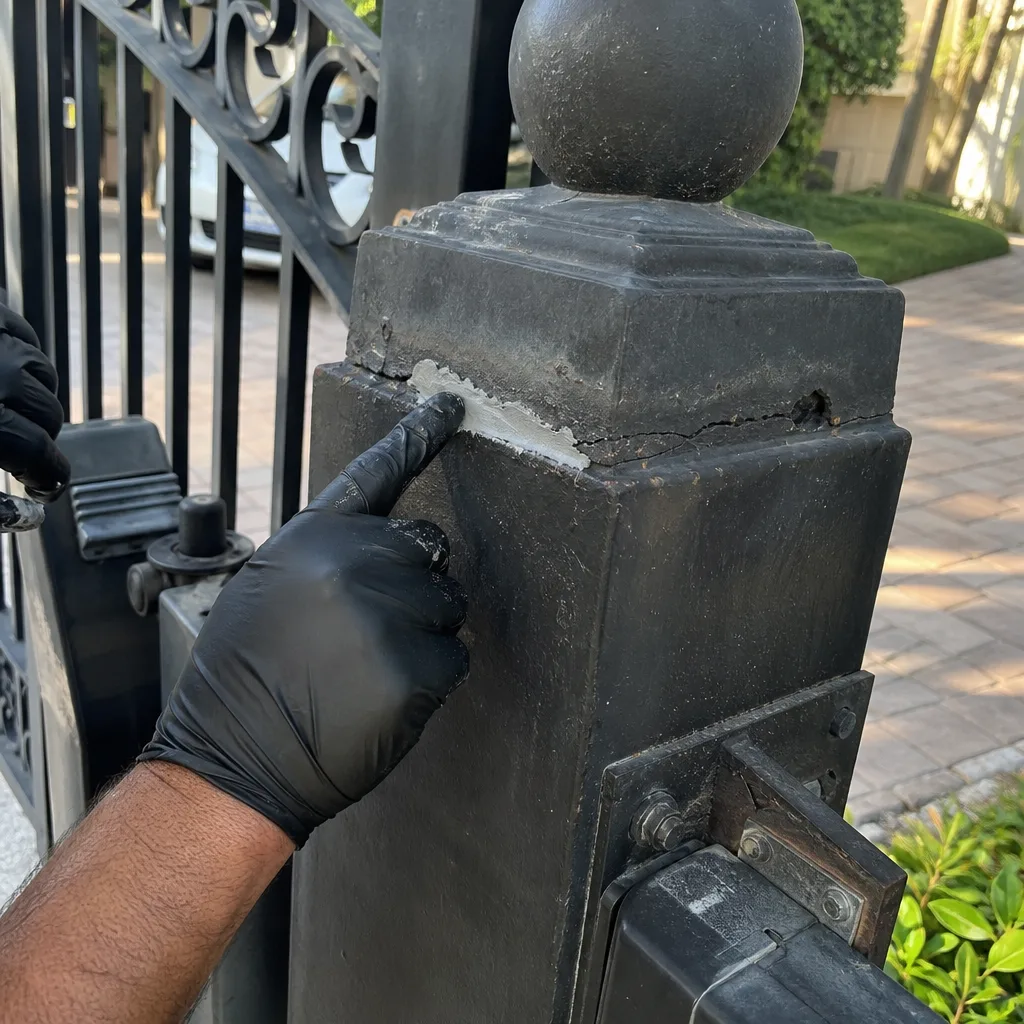
After any significant storm passes through West Palm Beach, you should walk your gate system looking for damage that isn’t immediately obvious. The gate may open and close fine in the driveway, and still have hidden problems that will fail weeks or months later. This is the heart of our November failure pattern: the storm happened in September, but the gate failed in November.
Here’s the post-storm inspection sequence we use, in priority order:
Our gate repair services in West Palm Beach include a full post-storm inspection with photo documentation, so you have a written record of what was found and what was corrected.
Dry Season (December-March): Lubrication Schedule and Metal Fatigue Assessment
December through March is West Palm Beach’s dry season, and it’s the best window for lubrication and metal inspection. Here’s why: lubrication is most effective when the surfaces are clean, and dry-season surfaces are clean because humidity-driven grime accumulation stops. When humidity drops below 55 percent, the salt and road film that normally clings to gate hardware dries and can be removed with a wipe-down. Then the right lubricant goes on, and it doesn’t immediately get diluted or contaminated by humid air.
The dry season is also when metal fatigue becomes visible. During humid months, rust and corrosion are active and visible, which actually makes them easier to spot. During dry months, existing corrosion stops spreading, but micro-cracks in stressed metal become more visible because the metal contracts slightly in the cooler, drier air. A crack that was invisible when the steel was heat-expanded in August may be visible in January. This is the window to find it.
Here’s the dry-season lubrication and inspection schedule we recommend for West Palm Beach gates:
If you find a crack in a weld or a hairline fracture that wasn’t there last year, we can assess it and repair it before it becomes a structural failure. Vance Gate Repair West Palm Beach handles both residential gate repair and light welding work in the local market.
Thermal Shutdown and Limit-Switch Sensitivity: Adjusting for Shoulder Seasons
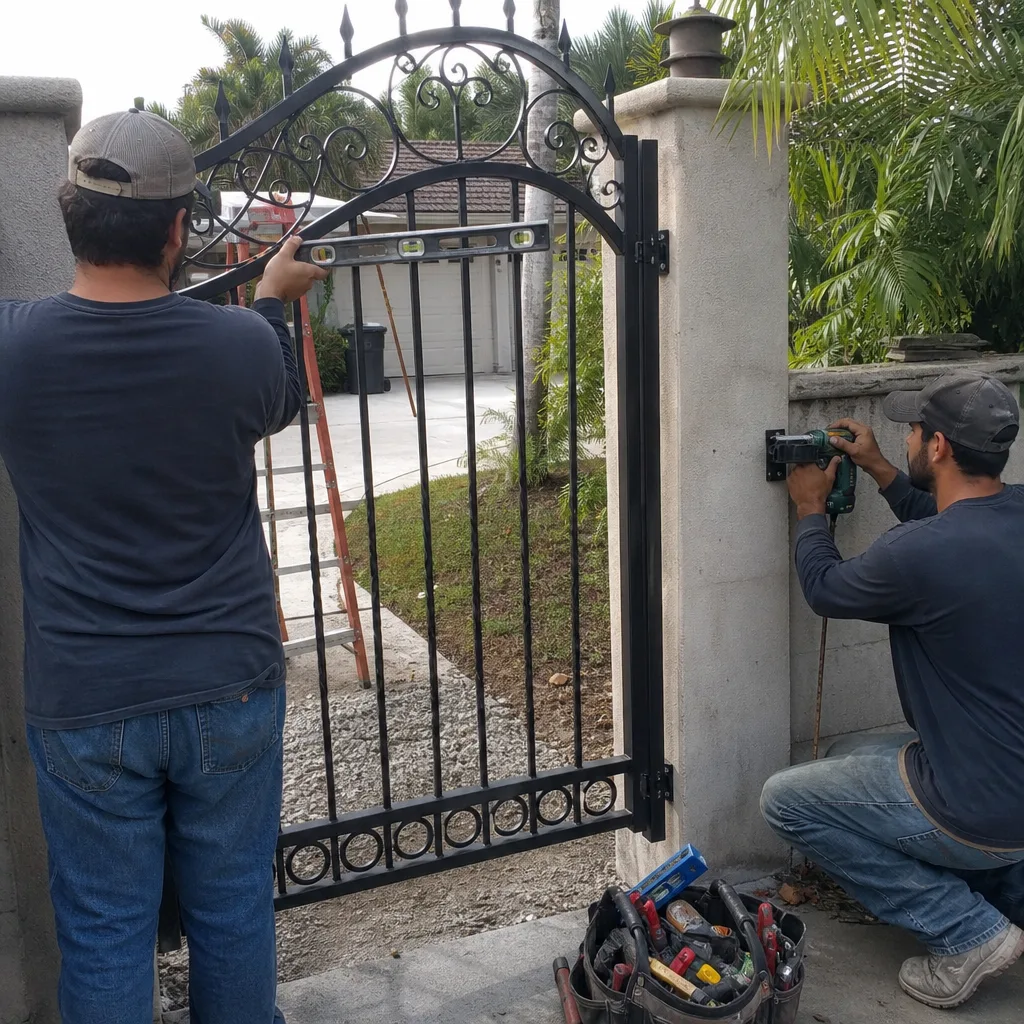
Every automated gate motor has a thermal overload circuit. When the motor runs hot, the overload trips, the motor shuts down, and the gate stops mid-travel or refuses to start until the motor cools. In West Palm Beach’s summer, this is a familiar pattern: a gate that works in the morning but fails at 3 p.m. on a 92-degree day. The motor heats up, the thermal sensor trips, and the homeowner assumes the opener is dead.
Thermal shutdown patterns shift between seasons, and understanding this shift prevents a lot of unnecessary motor replacements. Here’s what actually happens:
In summer, the ambient temperature plus the motor’s own operating heat pushes the thermal sensor close to its trip threshold. A gate that runs fine in May may trip repeatedly in August because the motor has less thermal headroom. This is not a motor failure. It’s a tuned operating envelope that needs adjustment.
In shoulder seasons, October and November, a different pattern emerges. The afternoon temperatures are moderate, but the sun angle is lower, which means the motor housing absorbs heat differently. A motor mounted in an unshaded location on the west side of the property gets direct afternoon sun at a different angle in November than in July. The housing may actually get hotter in November than in August, even though the air temperature is lower. This causes thermal trips that confuse homeowners who think cooler weather should mean fewer problems.
Limit-switch sensitivity shifts too. Limit switches tell the motor when the gate has reached the end of its travel. They’re often mechanical, with a small cam or contact that moves as the gate travels. Temperature changes alter the gate’s dimensions slightly. An aluminum gate panel 16 feet long expands and contracts significantly between a 50-degree January morning and a 90-degree July afternoon. That dimensional change means the limit switch setting that was perfect in January will be slightly off in July, and vice versa.
The practical adjustment for West Palm Beach homeowners:
These adjustments are small, fast, and inexpensive when caught early. Let them go for a full season and the repeated thermal cycling accelerates motor bearing wear, and now you’re looking at a motor replacement that was avoidable.
If you’re considering a full gate installation in West Palm Beach, we factor the sun exposure of the motor location into the design so thermal shutdown risk is minimized from day one.
The Seasonal Log Template: A One-Page Record That Saves Real Money
The single most valuable thing you can do for your gate in West Palm Beach is keep a one-page seasonal log. This is not a guess about the future. It’s a record of what actually happened, and it has real money attached to it: the next technician who services your gate will spend less time diagnosing because the history is written down, and less diagnosis time means a smaller invoice.
Here’s the log template we recommend. Print it, fill it out each season, and keep it in a folder near the gate control board, or store photos of it on your phone:
Seasonal Gate Log - West Palm Beach
Quarter: (Example: April-May, Pre-Hurricane)
Date inspected:
Inspected by: (Homeowner or technician name)
Gate type: (Swing / Slide / Barrier)
Motor brand and model:
Battery age and last load-test date:
What I checked:
Action items: (What needs fixing, by when, and who’s doing it)
This log is the paperwork equivalent of pre-storm photos. It gives any future technician, including us, a year-over-year baseline. When we’re called to a West Palm Beach home and the owner hands us a log like this, we spend our time on the actual repair rather than re-discovering the gate’s history.
Under our Haven Standard, specifically Clause 4 (Evidence on every job), every visit includes a documented photo record at no additional charge. That means when we service your gate, you get the photos that become part of your log automatically. You never have to remember to document what we fixed; it’s part of the service. That’s the same documentation habit Adrian Vance developed on commercial access-control sites starting in 2014, applied to residential gates.
Common Mistakes to Avoid
When to Call a Professional
Some gate work is straightforward for a homeowner with basic tools, and some genuinely requires a trained technician. Here’s the line: if the problem involves the motor, the control board, the battery, or any wiring, call a professional. These systems carry AC power, DC battery power, and a network of sensors, and a mistake on the control board can mean replacing a $200 board instead of fixing a $20 wiring connection. High-tension springs on some older swing gates are also not a DIY item; a spring under load can cause serious injury if released incorrectly. If your gate won’t move, if it’s tripping repeatedly, if you hear grinding, or if you see sparking anywhere in the system, call. Vance Gate Repair West Palm Beach offers free estimates in West Palm Beach and serves the full local area. Call (561) 725-8048 and a live person will answer, day or night.
Frequently Asked Questions
A basic seasonal inspection, including a battery load test, photo-eye alignment check, hinge lubrication, and limit-switch verification, typically runs between $95 and $180 in West Palm Beach, depending on the gate type and whether any adjustments are needed. If the inspection uncovers a repair, the repair is quoted separately and in writing before any work starts. Call (561) 725-8048 for an exact quote; estimates are free and the written price is confirmed before we touch a tool.
Twice a year, minimum. Once before hurricane season (April or May) and once in the dry season (January or February). If your gate is within two miles of the Intracoastal or faces an exposed corner lot, add a third inspection in October to catch post-storm damage before it becomes a November failure. The seasonal log above gives you a framework for spreading the work across the year.
Yes. A live person answers the phone at (561) 725-8048 at any hour. If you’re locked in or out and the repair is urgent, we’ll send a uniformed technician with the name and photo provided before arrival. Most common failures, including battery replacements, photo-eye realignment, and limit-switch resets, can be completed on the first visit.
Yes. Power loss in West Palm Beach during storm season is not a rare event, and a gate without battery backup becomes a manual gate (or a stuck gate) in the middle of the worst possible moment. Even a basic sealed lead-acid battery that operates the gate through 5 to 10 cycles is worth the cost. The key is load-testing the battery every spring. A battery that hasn’t been load-tested is a battery you can’t trust.
We work on all major gate-automation brands including LiftMaster, FAAC, BFT, and Linear, plus several others. We don’t steer toward a particular brand or toward replacement when a repair is feasible. If the motor on your gate is a FAAC and a FAAC replacement part is available, that’s usually the simplest and most cost-effective path.
That pattern is almost always thermal shutdown: the motor’s internal thermal overload trips when ambient heat plus operating heat exceeds the trip threshold. In West Palm Beach, this is most common in July through September and can also appear in October and November due to the shifting sun angle. It’s a limit-setting or housing-ventilation adjustment, not a dead motor, in the majority of cases. A technician can verify the pattern and make the adjustment quickly.
The Bottom Line
West Palm Beach doesn’t give your gate a break. Salt air, lightning, humidity, hurricane wind, and full summer sun work on the hardware year-round, each in a different way. The gate doesn’t fail suddenly; it fails on a schedule, and that schedule tracks the climate calendar. If you do the pre-hurricane checklist in April, load-test the battery in May, inspect for surge damage after every major storm, lubricate and inspect metal in the dry season, and keep a one-page log across all of it, you’ll catch most failures before they strand you. If you don’t, November will eventually catch you instead. When the log points to something beyond a homeowner’s scope, call (561) 725-8048. We’ll show up with a written quote before any work starts, a photo record when we leave, and a name on the work order for every visit.
Written by Adrian Vance, Owner at Vance Gate Repair West Palm Beach, serving West Palm Beach since 2014.